Noom Sound Studio  ·  Blog  ·  Is handpan hard to learn?

See everything on one page  →

Handpan · Koh Samui

Is the handpan hard to learn? A real beginner’s guide.

What a handpan actually is, why beginners do better on it than they expect, and what a first lesson in Koh Samui looks like.

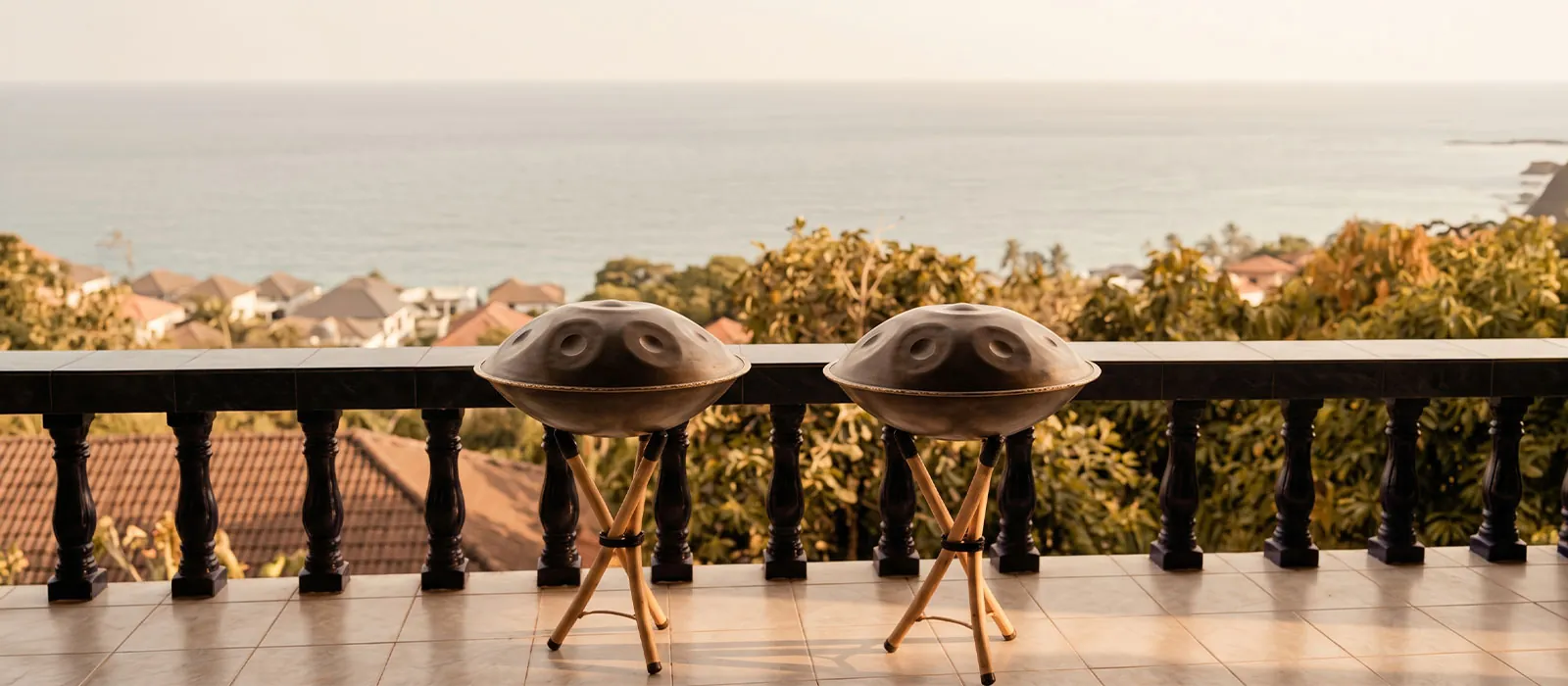
Handpan lesson on the terrace at Noom Sound Studio, Koh Samui

If you have stood near one at a market or a beach bar and watched someone play, the handpan probably looked harder than it is. That reaction is common, and it is also backwards. The instrument is built, deliberately, to make beginners sound decent within minutes. Here is why, and what to actually expect if you want to try one.

The instrument

What a handpan is, and why it is not that old.

A handpan is two shallow steel bowls joined at the rim, with a domed centre note and seven or eight tuned dents, called tone fields, arranged around it. You play it with your fingers and thumbs, not sticks. There is no keyboard, no strings and no frets: the note comes from the shape and hardness of the steel itself, hand-hammered into place by the maker.

It is a young instrument. The first one, called the Hang, was built in Bern, Switzerland, in 2000 by Felix Rohner and Sabina Schärer, after a percussionist named Reto Weber visited their workshop and described wanting a metal instrument you could play directly with your hands, and showed them the ghatam, a hand-struck clay pot from South India (PANArt, Wikipedia). It went public at a music trade fair in Frankfurt in 2001. Within a few years, other makers built their own versions and the general name “handpan” stuck. So when a handpan feels ancient or ceremonial, that is the sound talking, not the history. There is no centuries-old tradition to learn correctly or get wrong.

The physics behind the sound is genuinely elegant. Striking a tone field sets the steel vibrating, and that vibration couples with the air sealed inside the drum’s two shells, a Helmholtz resonance, the same basic effect as blowing across the top of a bottle (Instruments du Monde). That coupling is what gives a single note its long, bell-like sustain instead of a short metallic clang.
The learning curve

Why beginners do better than they expect.

Every handpan is tuned to one scale before it ever reaches you. The maker chooses the notes and hammers them in, so whatever two or three notes you touch, they already belong together. There is no wrong note to avoid and no music theory required to start. This is the actual mechanism behind “beginners do well on handpan,” and it holds up: most people who try one produce something that sounds intentional inside the first few minutes, not because they have hidden talent, but because the instrument removed the part that normally takes months, learning which notes are allowed.

General estimates from handpan teaching resources put basic proficiency, simple repeating patterns played cleanly, at somewhere around ten to twenty hours of practice for most people, spread over a few weeks (Cosmos Handpan). That is not a controlled study, just a rough consensus across people who teach the instrument regularly, but it matches what shows up in an actual first lesson: a simple, repeatable pattern within the first hour, and a short piece you can call your own within a handful of sessions.

Before you start

Common questions people actually ask.

More logistics questions like these, from pricing to what happens if it rains, are answered in full on the FAQ page.

Do I need to own a handpan first? No. Any reasonable teacher provides an instrument for lessons. You only need to think about buying one if you decide you want to keep going after you try it.

What does a handpan cost, if I do want my own eventually? Expect somewhere in the range of $1,500 to $4,000 for a good instrument from an established maker, and a wait list at many workshops, since each one is hand-tuned individually (Cosmos Handpan). This is not a decision to make before a first lesson, and a decent teacher will walk you through scales and makers rather than pushing you toward a purchase.

Is it too late to start as an adult? No, and this comes up constantly, especially from people who assume musical instruments are a childhood window that closed. Nothing about the handpan rewards starting young. No sheet reading, no scales to memorize, no years of theory behind the people who play it well. Hands that have never touched an instrument are the normal starting point, not the exception.

Do I need to be musical already? No more than you need rhythm to walk. If you can tap a steady beat with your hand, you have what the first lesson needs.

Logistics

What makes somewhere like Koh Samui work for learning.

The honest reasons come down to logistics more than mystique. A handpan lesson does not need a soundproof room, so it works well outdoors, on a covered terrace, which means weather rarely cancels a session and the setting does some of the relaxing for you before you have even started. Because the instrument is provided rather than something you need to bring or buy, a short trip is enough time to properly try it: a single demo lesson to find out if it suits you, or a short multi-session course timed to fit a week or two on the island, rather than needing a standing weekly commitment at home. If you are already on Samui for a stay, that structure fits a holiday better than a long-term studio enrolment would.

What to expect

What a first lesson actually looks like.

You show up, you are handed a handpan, and you are shown where to touch it and how lightly. Most of the first lesson goes into touch, learning to strike the steel so a note opens up cleanly instead of clicking, and simple timing, not music reading. By the end, most people can play a short repeating pattern that already sounds like something, and that is the whole bar for a first lesson: not mastery, just proof that it is possible, faster than most people expect.

If that sounds worth trying, the handpan lessons in Koh Samui start with a single demo session, no experience or commitment required, so you can find out firsthand rather than take a blog post’s word for it.

Sources

What was cited.

The History of PANArt. PANArt Hang Manufacturing Ltd. panart.ch

Hang (instrument). Wikipedia. en.wikipedia.org

What Is a Handpan? How Does It Work? Instruments du Monde. instruments-du-monde.com

How much time does it take to learn handpan? Cosmos Handpan. cosmoshandpan.com

Are Handpans Hard To Learn? A Quick Guide On Getting Started. Cosmos Handpan. cosmoshandpan.com

Try it yourself

Start with one afternoon.

A demo lesson is ฿2,000, no commitment and no experience needed.

WhatsAppBook