Noom Sound Studio · Blog · What happens in a sound bath
Sound healing · Koh Samui
A walk through what actually happens during a session, from the first tone to the way your body responds, with the research behind why it works.

You lie down, someone plays a gong, and an hour later you get up feeling like you slept for a night. That is the short version, and it is close to what actually happens at the weekly terrace sessions in Koh Samui. Here is the longer one: what is actually happening to your body and attention while it happens, and why an hour of listening does something a lot of us cannot get from an hour of trying to relax on purpose.
The first few minutes
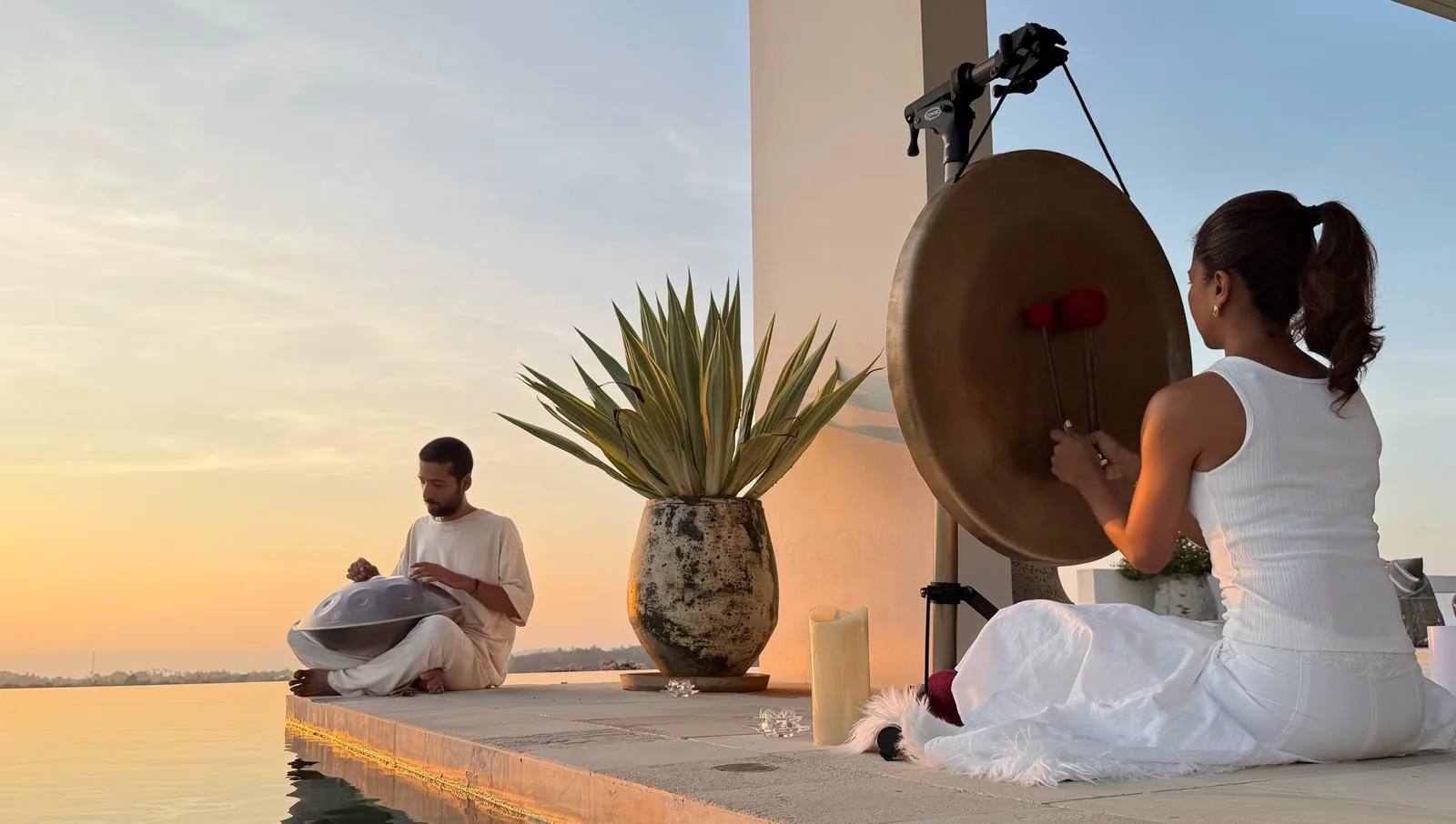
Most of what makes daily life tiring is not any single task. It is the switching: between the phone, the conversation, the thing you forgot to send, the next thing on the list. A sound bath removes almost all of that in one move. There is one sound source, usually a handpan, gong or singing bowl, and nothing else asks for your attention. No screen, no decision, nothing to reply to.
This matters more than it sounds like it should. Research on meditation has found that people who practice regularly show measurably reduced activity in the brain’s default mode network, the system responsible for mind-wandering and self-referential thought, during focused-attention practice (Brewer et al., PNAS, 2011). Nobody has scanned a brain during an actual gong bath, so this is an honest extrapolation rather than a proven fact about sound baths specifically. But giving attention a single, slow-moving target to rest on is the same basic move a lot of focused-attention meditation makes, and it is a plausible reason a session can feel like it switches something off in your head that has been running all day.
The middle stretch
Somewhere around ten to twenty minutes in, most people notice their breathing has slowed without trying to slow it. This is the parasympathetic nervous system, the “rest and digest” half of the autonomic nervous system, taking over from its opposite number, the sympathetic “fight or flight” half that most of a normal day runs on. Herbert Benson at Harvard Medical School named this shift the relaxation response decades ago: a real, measurable physiological state involving lower heart rate, lower blood pressure and reduced stress hormones, triggered reliably by a calm setting and a simple point of focus (Benson, Brigham and Women’s/Faulkner Hospital).
Long, sustained tones seem particularly good at this. Because there is no beat to count and no lyric to follow, there is nothing for the analytical part of the mind to grab onto and start working. A 2017 study of singing bowl meditation found significant drops in tension, anger, fatigue and low mood after a single session, with the largest improvements in people who had never done anything like it before (Goldsby et al., 2017). A more recent randomized trial comparing structured sound meditation against music alone found the sound group had significantly greater reductions in anxiety, depression and salivary cortisol (PMC, 2025), which suggests the structure and live format of a proper session add something on top of simply hearing pleasant sound.
The variation
Ask ten people what a sound bath feels like and you will get ten different answers, and all of them are normal. Some people get goosebumps or a shiver down the spine, a response researchers call frisson, tied to dopamine release in the brain’s reward system at emotionally peak moments in music (Salimpoor et al., Nature Neuroscience, 2011). Some people just feel calm and a little sleepy. Some fall properly asleep, which is not a wasted session, it is usually a sign the body relaxed enough to let go of vigilance. A small number of people notice very little at all and just leave feeling rested, which counts too. There is no correct response to aim for, and trying to force one tends to get in the way of it.
Live versus recorded
A gong or handpan played in the room with you is not the same signal as the same instrument recorded and played back through speakers. Every strike is slightly different, the tone moves and decays in real time, and the room itself is part of the sound. There is not much direct research isolating this specific difference yet, so this is more a matter of acoustics and reported experience than settled science: an unpredictable, live source keeps a light thread of attention active, something is genuinely happening, right now, near you, in a way a loop rarely does, even while the body drops into deep rest. That combination, alert enough to stay present, relaxed enough to properly let go, is closer to what people usually mean when they say a session felt different from just playing a relaxation playlist at home.
What it adds up to
None of this is treatment, and none of it is being sold as one here. What the research does support is that a quiet room, one simple and slow-moving sound, and an hour with nothing required of you is a genuinely effective way to trigger a real, measurable relaxation response. That is the honest scope of it, and for most people looking for an hour of proper rest, it is more than enough reason to try one.
If you want the specifics before you book, from what to wear to what happens if you fall asleep, the full FAQ covers all of it.
Sources
Brewer JA, et al. Meditation experience is associated with differences in default mode network activity and connectivity. PNAS (2011). pnas.org
Benson H. The Relaxation Response. Brigham and Women’s/Faulkner Hospital. brighamandwomensfaulkner.org
Goldsby TL, Goldsby ME, McWalters M, Mills PJ (2017). Effects of Singing Bowl Sound Meditation on Mood, Tension, and Well-being: An Observational Study. pubmed.ncbi.nlm.nih.gov
Effects of a Sound-Based Meditative Intervention on Anxiety, Depression, Salivary Cortisol Levels, and Blood Pressure: A Randomized Controlled Trial. PMC. pmc.ncbi.nlm.nih.gov
Salimpoor VN, et al. Anatomically distinct dopamine release during anticipation and experience of peak emotion to music. Nature Neuroscience (2011). pubmed.ncbi.nlm.nih.gov
Try it yourself
Open sessions run every Wednesday and Sunday at 17:30 on the terrace in Lamai.