Noom Sound Studio  ·  Guides  ·  Starter’s guide to handpan

See everything on one page  →

Handpan · Playing guide

Starter’s guide to handpan, your first week.

You do not need to read music. Here is how to sit, where to touch, and what to practise in your first week.

By Can, Noom Sound Studio, Koh Samui. Updated 3 October 2026.  ·  ภาษาไทย
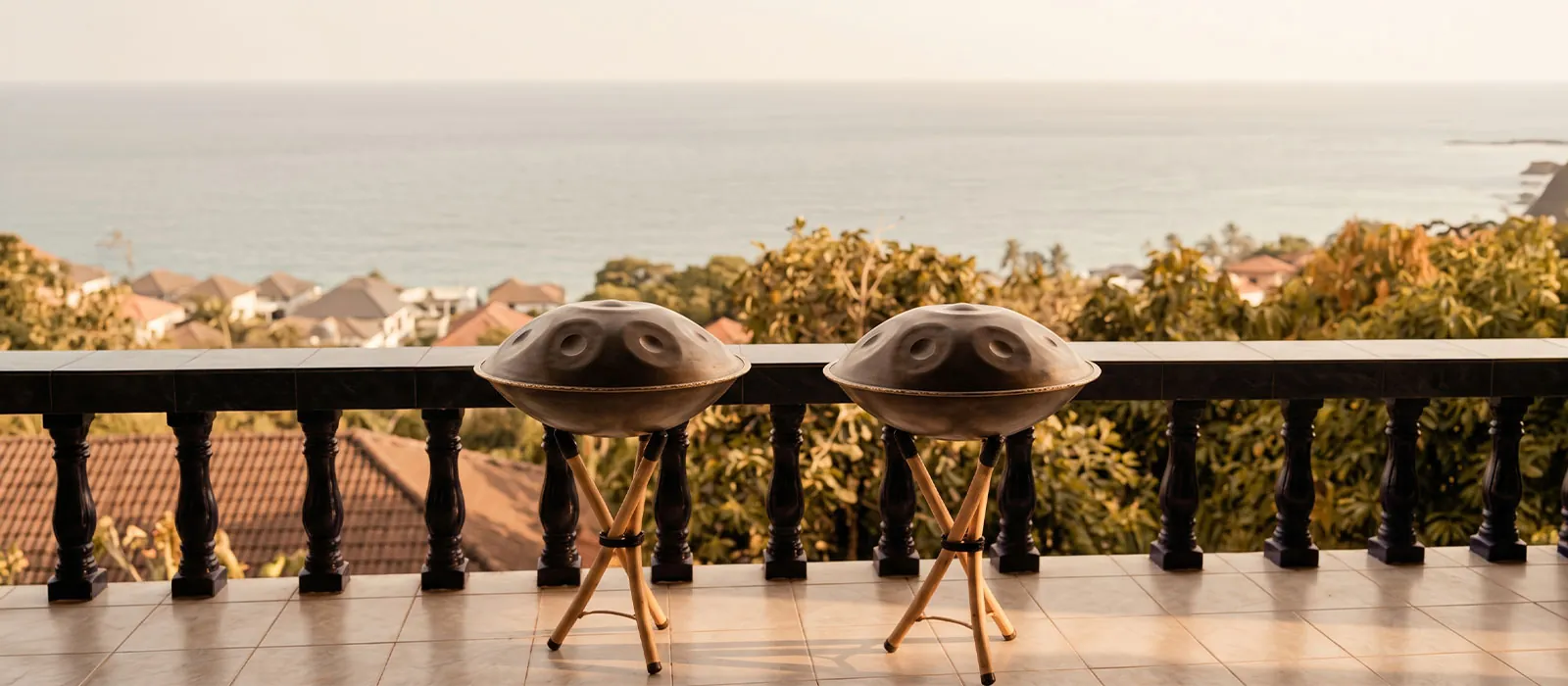
Handpan lesson on the terrace at Noom Sound Studio, Koh Samui

The short answer

Sit, tap, keep it steady.

Get comfortable, tap with the pads of your fingers, keep a steady pulse and play for ten minutes a day. There is no talent involved, only trained muscles and steady practice.

The instrument

What a handpan is, and how it makes sound.

A handpan is a steel instrument with a domed centre and tuned dents around it, called tone fields. You play it with your fingers and thumbs. The maker tunes every note to one scale, so notes you play together already belong together.

The layout

Know your notes.

The centre note is the ding. It is a D. The tone fields around it are numbered from the lowest note up. On a D Kurd 9 they run 1 to 8, with 1, 3, 5, 7 on the right side and 2, 4, 6, 8 on the left. A D Kurd 10 adds a 9, a high C.

I use these numbers in lessons and in the Learn section, so a pattern like 1 3 5 is the same for everyone.

Set-up

How to sit.

Sit with your back long and shoulders loose. Rest the handpan on your thighs with the ding in the centre and facing up, or place it on a stand at lap height. Keep your forearms level and your wrists relaxed.

First sounds

Where and how to touch.

Tap one tone field with the pad of a finger. Use a light touch and let your hand bounce off, like touching a warm cup. Let the note ring before you play the next one. Try every note in turn and listen.

If your fingertips hurt, you are pressing too hard. Soften your wrist and play quieter.

First rhythm

A steady pulse comes first.

Pick any two notes, one for each hand. Play right, left, right, left at a slow, even pace, and count four beats. A metronome at 60 beats per minute helps. Speed comes later, and it comes by itself.

No handpan yet? Practise the same pattern on your knees. It trains the same hands.

First melody

Your first pattern.

Play 1, 3, 5, 3, 1, 3, 5, 3, one note at a time, at a slow pace. These three notes make an A minor chord, so the pattern sounds finished. Then start each round with the ding: D, 1, 3, 5.

Play it at a slow pace until it feels easy. Then speed up a little.

Week one

Ten minutes a day.

Ten minutes every day beats one hour on Sunday. Short, regular practice builds the muscle memory. There are no deadlines.

Questions

What beginners ask.

How long until it sounds good? Teaching resources estimate ten to twenty hours of practice for simple patterns that sound clean, spread over a few weeks.

Do I need my own handpan to start? No. A lesson provides one, and you can practise rhythm on your knees. When you want your own, read how to choose your handpan.

Sources and further reading

Is the handpan hard to learn? Noom Sound Studio. /blog/is-handpan-hard-to-learn/

How much time does it take to learn handpan? Cosmos Handpan.

Next step

WhatsAppBook